
Microsoft's Medical AI Bet Is Embeddings, Not Answers
Most medical AI announcements promise a model that tells you something: this scan shows a bleed, this note means that diagnosis. Microsoft's healthcare catalogue is built on a different premise, and that premise changes what you build with it.
MedImageInsight, the centrepiece, does not produce a diagnosis. It produces a 1024-dimensional vector. That sounds like a downgrade and it is closer to the opposite.
What an embedding model actually gives you
MedImageInsight maps medical images and text into a shared 1024-dimensional vector space, across nine modalities: X-ray, CT, MRI, clinical photography, dermoscopy, histopathology, ultrasound, and mammography.
Because images and text land in the same space, a handful of capabilities fall out without training a classifier for each:
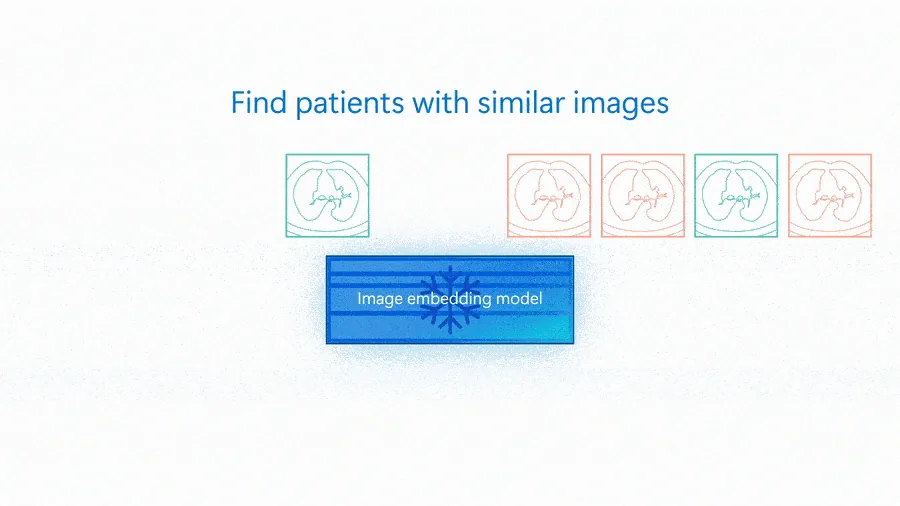
- Similarity search. Given this scan, find the most similar scans in our archive. Radiologists have wanted this for twenty years and it has never worked well.
- Zero-shot classification. Compare an image embedding against text embeddings for candidate findings. No labelled training set required.
- Cohort building. Retrieve every study in a corpus matching a visual pattern, whether for a trial, a retrospective study, or a QA audit.
- Cheap adapters. Freeze the embeddings, train a small head on your specific task with a fraction of the labelled data a full model would need.
That last one is the practical argument. Labelled medical data is the binding constraint in this field. Annotating a CT volume costs radiologist time at radiologist rates, and for rare conditions there may only be a few hundred confirmed cases globally. A good embedding model converts "train a model" into "train a small adapter", and that changes which projects are possible at all.
Microsoft's own framing is exactly this: researchers use the embeddings and build adapters for their specific tasks across radiology, pathology, ophthalmology, dermatology and other modalities.
Mass General Brigham is using it to surface additional relevant information during clinical research and to streamline radiologist workflows, which is the cohort-building and similarity-search case, not a diagnostic one.
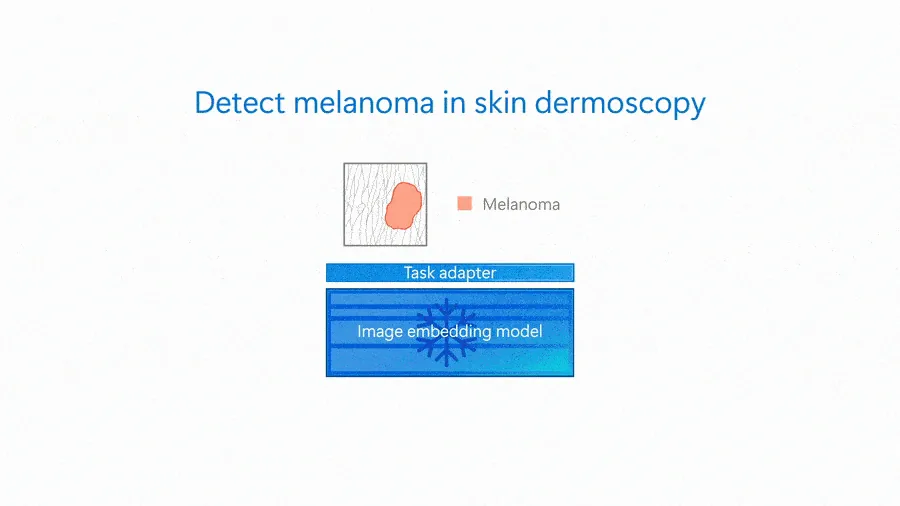
The adapter pattern: keep the embedding model frozen and train a small task adapter on top. Source: Microsoft
The rest of the catalogue
MedImageInsight arrived alongside two siblings, and the three divide the imaging problem cleanly.
MedImageParse does segmentation: delineating structures across X-ray, CT, MRI, ultrasound, dermatology and pathology images, fine-tunable for tumour segmentation or organ delineation. This is the U-Net problem at foundation-model scale, and segmentation is what turns "there is something there" into a measurement a clinician can act on.
CXRReportGen generates structured reports from chest X-rays, incorporating the current image, prior images, and key patient information, and it highlights AI-generated findings directly on the image.
That last detail is a genuinely good design decision. Draft report text that is wrong enters the record and anchors the reader; automation bias research is unambiguous that a confidently wrong suggestion makes clinicians worse than no suggestion. Grounding each generated finding to the pixels that produced it gives the radiologist a cheap way to disagree: look at where it is pointing. Microsoft describes this as aligning with human-in-the-loop workflows, and the phrase is doing real work.
Beyond Microsoft's own models, the catalogue carries partner contributions from Paige (pathology), Providence Healthcare, NVIDIA (3D medical imaging), and M42. Access comes in two tiers: open models for research and prototyping, and premium closed-weight variants with enterprise licensing, HIPAA coverage and SLA-backed deployment. MedImageInsight Premium is the serverless closed-weight version spanning all nine modalities.
BioGPT, and being honest about it
BioGPT is the other model that gets named in Microsoft's healthcare lineup, and it deserves a more careful treatment than it usually gets.
It is a GPT-style model trained on PubMed, and it demonstrated state-of-the-art results on PubMedQA at the time, with strong performance on biomedical relation extraction and summarisation. It was a genuinely important contribution.
It has also been overtaken. On PubMedQA-style evaluation, BioGPT's 0.732 accuracy sits below GPT-3 at 0.814 and BioMedLM at 0.806, and the open medical LLM ecosystem has moved considerably since. OpenBioLLM-70B reports an 86.06% average across nine biomedical datasets.
So if you are choosing a biomedical language model today, BioGPT is a reference point rather than a recommendation. Its enduring value is architectural: it established that domain-specific pretraining on biomedical text beats general models at biomedical extraction tasks, and that finding held up even as the specific weights aged.
Note the pattern generally: the imaging half of Microsoft's healthcare stack is current, and the language half is not. Microsoft's recent investment has clearly gone into multimodal imaging, where its differentiation is real, rather than into competing on medical text where open models from other labs now lead.
Where this sits against Google
The two stacks are less competitive than they look, because they target different builders.
Google's HAI-DEF ships downloadable generative models. MedGemma reads an image and produces findings text, MedASR produces a transcript. You get an answer you evaluate.
Microsoft's catalogue ships representation and workflow infrastructure: an embedding space, a segmenter, a report generator with visual grounding, wrapped in Azure with HIPAA coverage and SLAs.
If you are a research team fine-tuning models on your own hardware, Google's 4B MedGemma is the more natural starting point. If you are a health system that needs enterprise licensing, compliance coverage and a deployment path your legal department will sign, Microsoft's premium tier exists for exactly that and Google's open weights do not answer it.
The honest read is that most serious deployments will end up using both, because embeddings and generation solve different halves of the problem.
Practical notes
Test cross-site generalisation before anything else. Embedding models are more robust to domain shift than task-specific classifiers, and more robust is not immune. Different scanners, different reconstruction kernels, different staining protocols. Run your own scanners through it and check the neighbourhoods still make sense.
Similarity search is the fastest win. It needs no labels, no fine-tuning, and no regulatory pathway if it is a research and retrieval tool rather than a diagnostic one. If you have a large imaging archive, this is the cheapest thing on this page to try.
Understand what tier you are on. Open models are for research and prototyping. If patient data touches it in production, you need the premium tier with the HIPAA coverage, and the licensing conversation should happen before the pilot rather than after.
Do not skip the human-in-the-loop design. CXRReportGen's visual grounding is a template worth copying whatever model you use. A draft finding a clinician can trace back to pixels is reviewable. One they cannot is just a confident assertion in their workflow, and the evidence on what that does to diagnostic accuracy is not encouraging.
Media credits:
- Hero image (embedding-based similar-image search) and task-adapter figure — Microsoft