💡 Meta Releases Muse Glimmer: An Open-Weight Agentic Model for Your Device
✨ A 30B-parameter agent model under Apache 2.0 that plans, calls tools and recovers from errors on your own hardware.
🌐 Introduction
Meta today released Muse Glimmer, an open-weight model from Meta Superintelligence Labs built for agents that run locally. It doesn't target the cloud chat use case. Glimmer is meant to run long, tool-heavy workflows on a single consumer GPU or a Mac with plenty of unified memory, with or without an internet connection.
💡 "Muse Glimmer is a 30-billion-parameter model optimized for always-on local agent workflows."
— Meta AI Research
The weights are on Hugging Face now under the permissive Apache 2.0 license. That marks a clear shift: Muse Spark, which Meta launched in April 2026, is a proprietary model.
🧬 Model at a Glance
| Spec | Muse Glimmer-30B |
|---|---|
| 📦 Parameters | ~29.6B language model, plus a ~1.8B ViT perception encoder |
| 🏗️ Architecture | Dense causal transformer, mixing local (sliding-window) and global attention |
| 📏 Context length | 131,072+ tokens |
| 🖼️ Modalities | Text and image in, text out (video is read as individual frames) |
| 🌍 Languages | Trained on data from more than 100 languages |
| 🧠 Reasoning control | Low / Medium / High / XHigh reasoning strength |
| 📅 Knowledge cutoff | January 4, 2026 |
| ⚖️ License | Apache 2.0 |
🖥️ Built to Run Locally
The headline claim is that Glimmer works as a complete agent inside a 24 GB or 32 GB memory budget. Meta says it tested the model on a MacBook M4 Max, an M5 Max and an Nvidia RTX 5090.
| Variant | Target Memory | Quality Impact (per model card) |
|---|---|---|
| Full precision (BF16) | 64 GB VRAM | Baseline |
| K-Quant-Dynamic | 32 GB VRAM | ~0.2% degradation |
| K-Quant-17GB | 24 GB VRAM | ~1.0% degradation |
Meta also ships a DFlash speculative-decoding draft model to speed up generation:
| Hardware | Baseline (tok/s) | With DFlash (tok/s) | Speedup |
|---|---|---|---|
| Nvidia RTX 5090 | 74.9 | 233.4 | 3.1x |
| Apple M5 Max | 26.6 | 50.2 | 1.8x |
| Apple M4 Max | 23.7 | 37.8 | 1.5x |
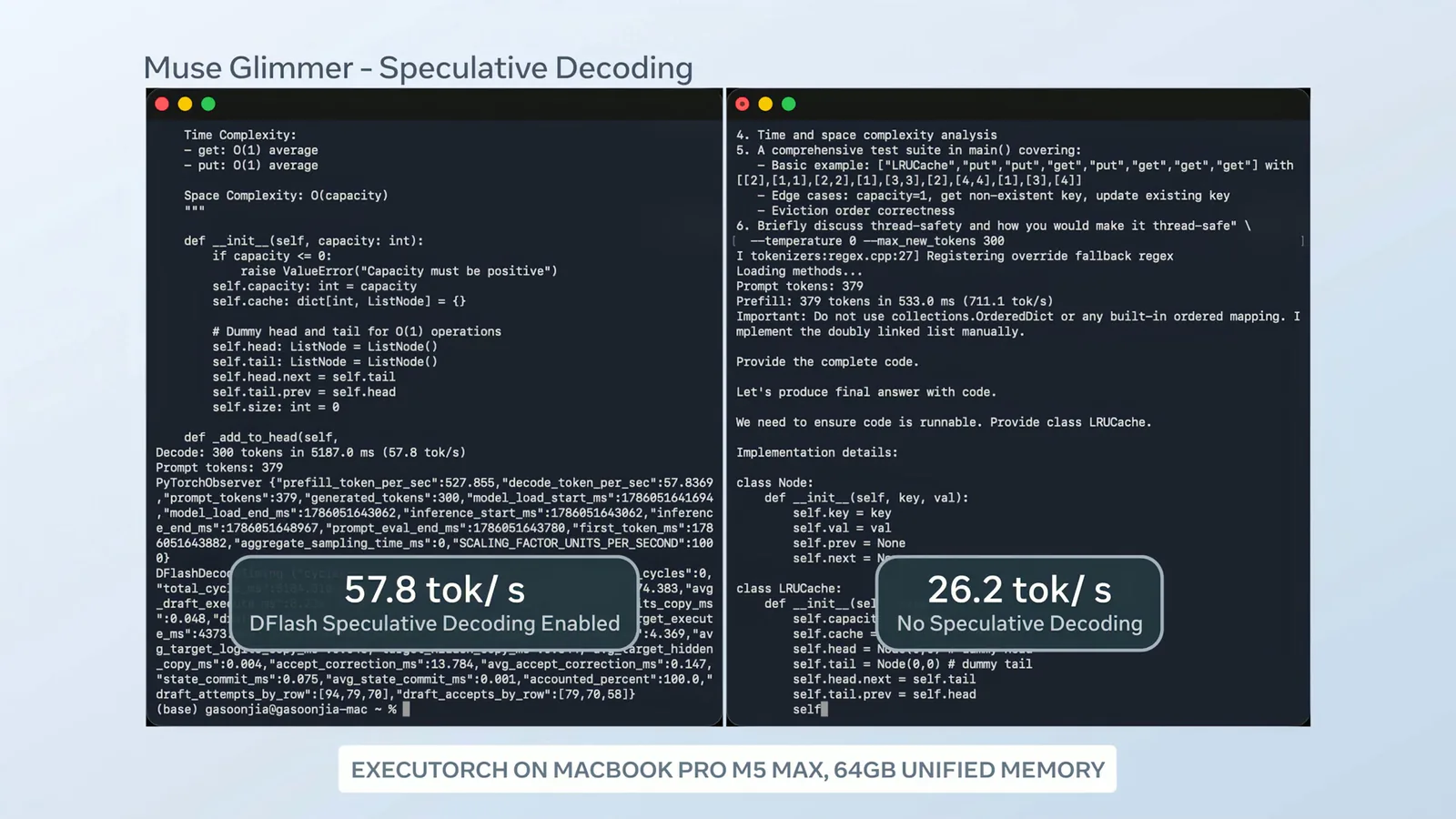
Meta's DFlash demo on ExecuTorch on a MacBook Pro M5 Max with 64 GB unified memory: 57.8 tok/s with speculative decoding vs 26.2 tok/s without. The demo's numbers differ slightly from the model-card table above. Source: Meta AI Research
💡 "Running models locally enables you to use AI anywhere, anytime, with or without an internet connection."
— Meta AI Research
📊 Benchmarks
Meta compares Glimmer with two open models in the same size class, Gemma 4 31B and Qwen 3.6 27B. These are selected results from the model card. Bold marks the best score in each row.
| Category | Benchmark | Muse Glimmer-30B | Gemma 4 31B | Qwen 3.6 27B |
|---|---|---|---|---|
| 🤖 Agentic | MCP Atlas | 75.5 | 54.2 | 62.5 |
| DeepSearch QA | 74.6 | 61.7 | 71.1 | |
| τ3-Banking | 23.5 | 15.1 | 16.7 | |
| WildClawBench | 47.6 | 37.6 | 43.2 | |
| 💻 Coding | SWE-Bench Pro | 51.2 | 36.9 | 50.2 |
| SWE-Bench Verified | 76.0 | 66.6 | 77.2 | |
| 🖼️ Multimodal | MMMU Pro | 74 | 73 | 75 |
| 🧮 Reasoning | AIME 2026 | 94.7 | 89.2 | 94.1 |
| GPQA Diamond | 83.5 | 85.7 | 84.2 |
The pattern is clear. Glimmer's biggest leads are on the agentic benchmarks, especially MCP Atlas, where it leads the next model by 13 points. On general coding, multimodal and science reasoning it is roughly on par with Qwen 3.6 27B. These are Meta's own numbers, so expect independent results to vary.
🛠️ Works With Your Existing Stack
💡 "Muse Glimmer is built to work with the tools developers already use."
— Meta AI Research
Day-One Ecosystem:
- 🧰 Local runtimes: llama.cpp, MLX, ExecuTorch, Ollama, LM Studio
- ⚙️ Serving and fine-tuning: Hugging Face Transformers, vLLM, SGLang, Unsloth
- ☁️ Hosted inference: Together AI, Fireworks AI, OpenRouter
- 📦 Weights:
meta-models/Muse-Glimmer-30Bon Hugging Face
VentureBeat reports that Meta is also working with AMD, Arm, Dell, Intel and Nvidia on performance optimization. It quotes Mark Zuckerberg as saying, "Meta is a strong supporter of open source."
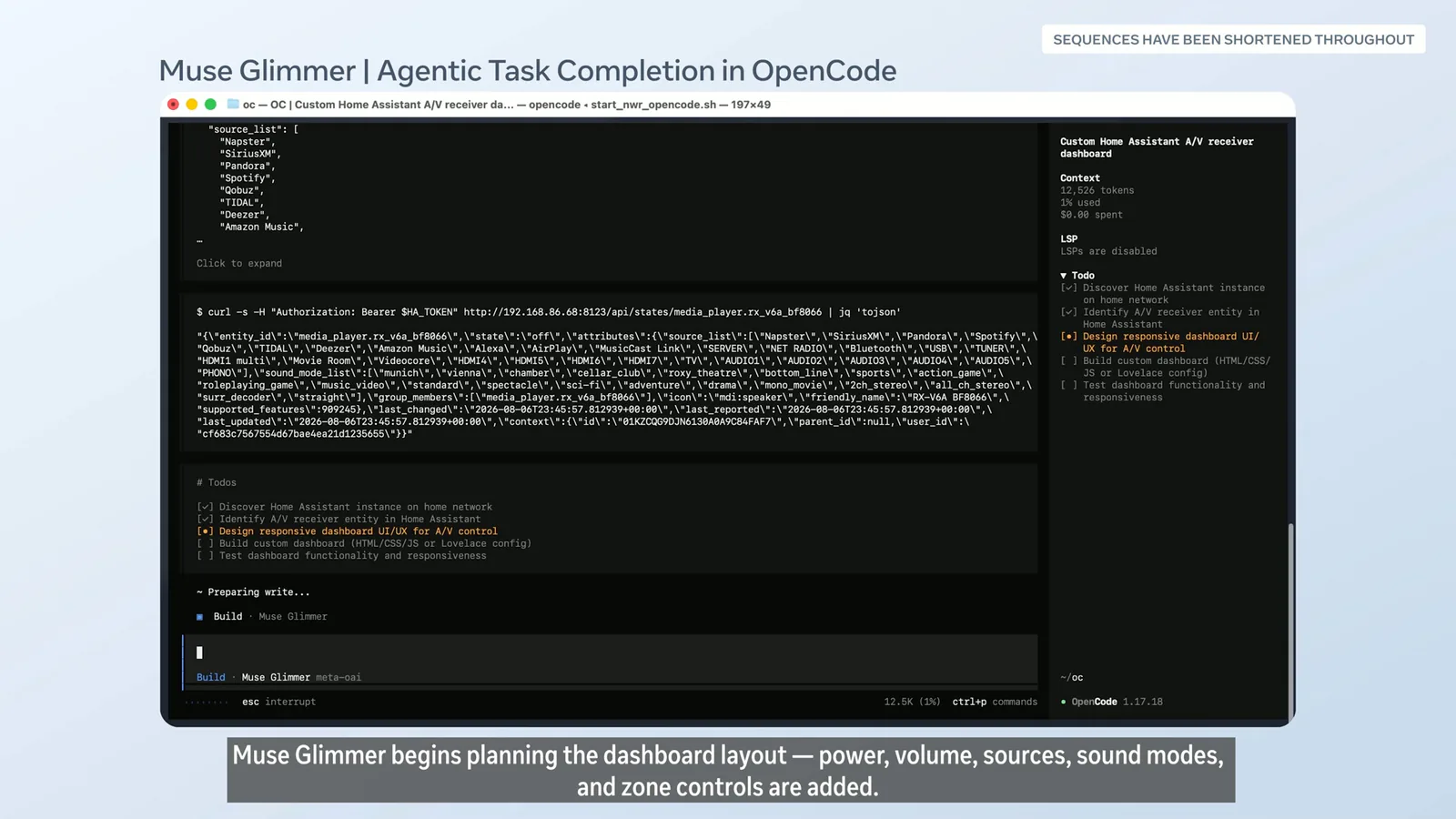
Muse Glimmer completing an agentic task in OpenCode, planning and building a Home Assistant dashboard (Meta notes the sequence is shortened). Source: Meta AI Research
⚖️ Why the License Matters
Meta's earlier open models used Llama's own community license, which included a 700-million-monthly-user threshold. Apache 2.0 has no such restriction. For commercial teams that should make legal review simpler. As VentureBeat notes, though, Meta has released the weights only. The training data and training code are not included.
💼 What It Means for Teams and Developers
For a consultancy building AI features for clients, Glimmer opens up some practical options:
| Use Case | Why Glimmer Fits |
|---|---|
| 🏥 Privacy-sensitive workloads | Agents can run entirely on-premises or on-device, so sensitive data in healthcare, legal or finance never has to leave the client's hardware |
| 💸 Predictable cost | A single 24–32 GB machine can replace per-token API spend for steady, high-volume agent tasks |
| 🔌 MCP-based tooling | Strong MCP Atlas results suggest it suits agents built on Model Context Protocol tool servers |
| 🧑💻 Local coding agents | SWE-Bench Pro performance makes it a candidate for offline or air-gapped developer tooling |
| 🧪 Evals and synthetic data | The model card lists LLM-as-a-judge and synthetic data generation as intended uses |
Practical takeaway: Pull the 24 GB quant into Ollama or LM Studio and run it against one existing agent workflow, with your own tools and your own test cases. Compare its success rate and failure recovery with your current hosted model before you decide anything.
⚠️ Limitations to Plan Around
From the Model Card:
- ⚠️ It can still make errors in multi-step reasoning, especially in novel scenarios
- 🎞️ Video is processed as separate frames, with no temporal understanding
- 🔇 No audio input or output
- 🌐 Quality varies across languages
- 📉 Quantized inference may show minor quality differences in edge cases
- 🔞 Not intended for users under 18
Meta rates the model moderate or lower for chemical/biological, cyber and loss-of-control risk under its Advanced AI Scaling Framework.
✨ Conclusion
Muse Glimmer is Meta's clearest statement yet that capable agents don't have to live in the cloud. A permissive license, broad runtime support on day one, and agentic benchmark results that lead its size class make it one of the most practical open models for teams that need local, private or low-cost agents. The real test will be how well its tool reliability holds up on real workflows outside Meta's own evaluations.
💭 The question is no longer "Which API should our agent call?" but "Does our agent need an API at all?"
Tags: #MuseGlimmer #Meta #OpenSource #OnDeviceAI #AgenticAI #AIModels #MetaSuperintelligenceLabs
Sources:
- Introducing Muse Glimmer: Open Agentic Model (Meta AI Research)
- meta-models/Muse-Glimmer-30B model card (Hugging Face)
- Meta returns to open source with Muse Glimmer (VentureBeat)
- Introducing Muse Spark: Meta's Most Powerful Model Yet (Meta Newsroom)
Media credits:
- Hero image: Muse Glimmer launch artwork — Meta AI Research
- In-body image: DFlash speculative decoding demo — Meta AI Research
- In-body image: agentic task completion in OpenCode — Meta AI Research