🚀 Google Releases Gemini 4 Argon: 1M Output Tokens, Built for Long-Horizon Work
✨ Google's new frontier model goes after long-running coding, enterprise knowledge work and cyber defense. It goes to defenders first, then to everyone else.
🌐 Introduction
Google today released Gemini 4 Argon, the first model in its Gemini 4 family and, according to Yahoo Finance, the company's first flagship model release since February. In the announcement post, Google DeepMind SVP Koray Kavukcuoglu says Argon delivers frontier performance across "real-world software engineering, enterprise knowledge work like legal and finance, and cybersecurity defense."
The headline spec is the output budget. Argon can produce up to 1M output tokens, up from the previous 64K limit. That matters most for agentic work, where a model has to plan, write and revise over many steps without being cut off.
💡 "Argon can autonomously find, validate, and patch critical software vulnerabilities."
— Google, Gemini 4 Argon announcement
🎯 What Argon Is Built For
Google is positioning Argon around three kinds of long, multi-step work:
| Focus Area | What Google Says | Example From Google |
|---|---|---|
| 💻 Software engineering | Strong on real-world coding, debugging and codebase migrations | A memory-safe video decoder that runs 2.7x faster than the Rust port |
| 📚 Enterprise knowledge work | Legal, finance and research workflows | Leading score on the Vals Index (finance, coding, legal, tax) |
| 🛡️ Cybersecurity defense | Finds, validates and patches vulnerabilities autonomously | Tied for first on CWE-bench v1 (vulnerability remediation) |
Google also says it already uses Argon internally. One server fleet optimization the model worked on is expected to free over 300 TiB of memory once rolled out, and Google estimates total savings at 500 TiB to 1 PiB.
📊 Benchmarks: What Google Claims
Google published a comparison table against OpenAI's GPT-6 Astra and Anthropic's Claude Fable 5.1 and Claude Opus 5.5. According to OfficeChai's reading of that table, Argon is first or tied for first on 14 of 19 benchmarks. All of the figures below come from Google, not from independent testing.
✅ Where Google says Argon leads
| Benchmark | Gemini 4 Argon | Closest Rival (per Google) |
|---|---|---|
| DeepSWE v1.1 (software engineering) | 77.9% | Opus 5.5: 74.2%, GPT-6 Astra: 74.1% |
| AutomationBench | 51.3% | Opus 5.5: 42.5% |
| GraphWalks (256K to 1M tokens) | 84.2% | GPT-6 Astra: 71.8% |
| LVBench (long video) | 91.7% | GPT-6 Astra: 87.5% |
| Harvey Legal Agent Benchmark | 19.6% | Fable 5.1: 6.7% |
| CWE-bench v1 (vuln remediation) | 68.0% | GPT-6 Astra: 68.0% (tie) |
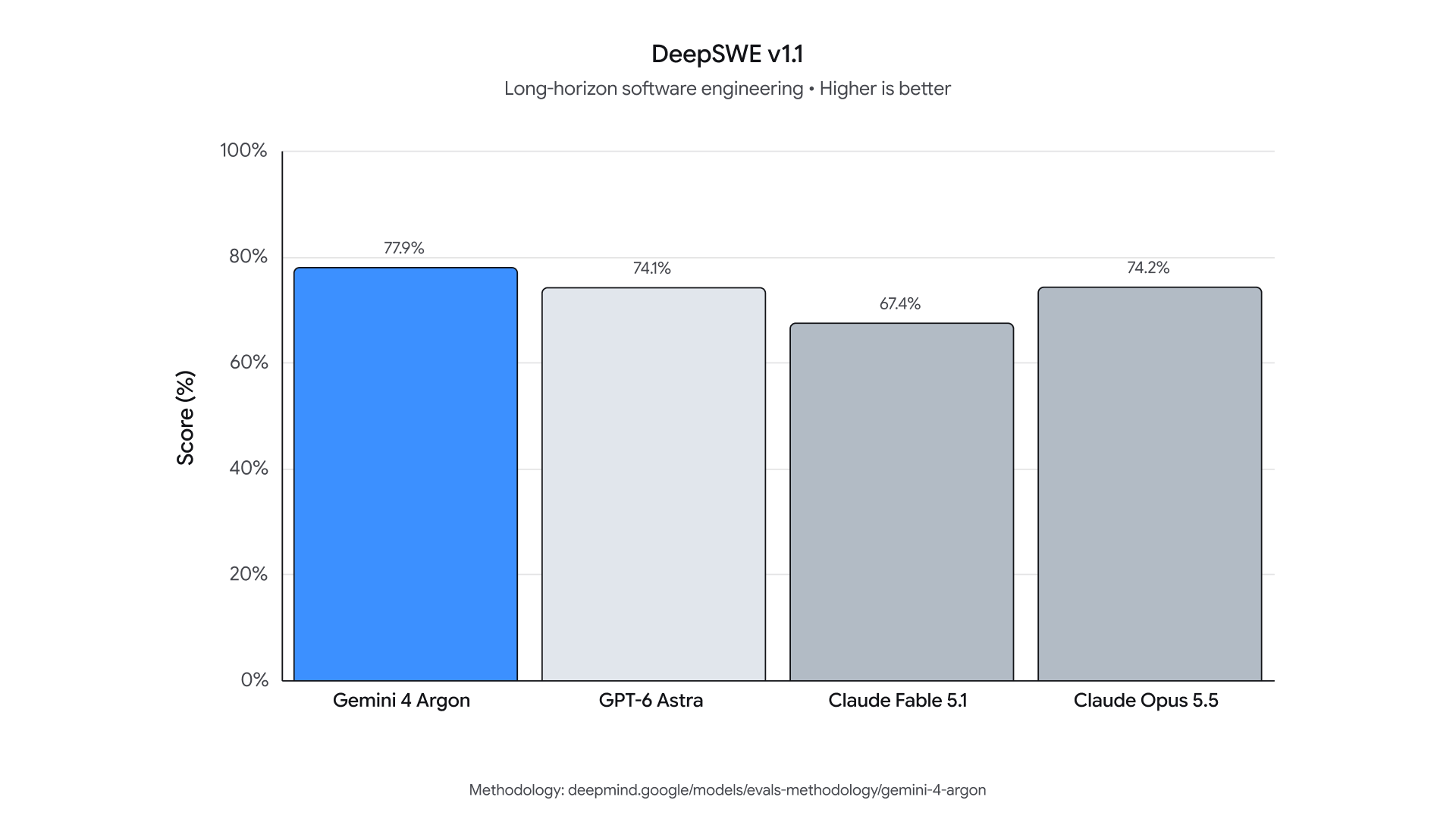
DeepSWE v1.1 (long-horizon software engineering). Source: Google
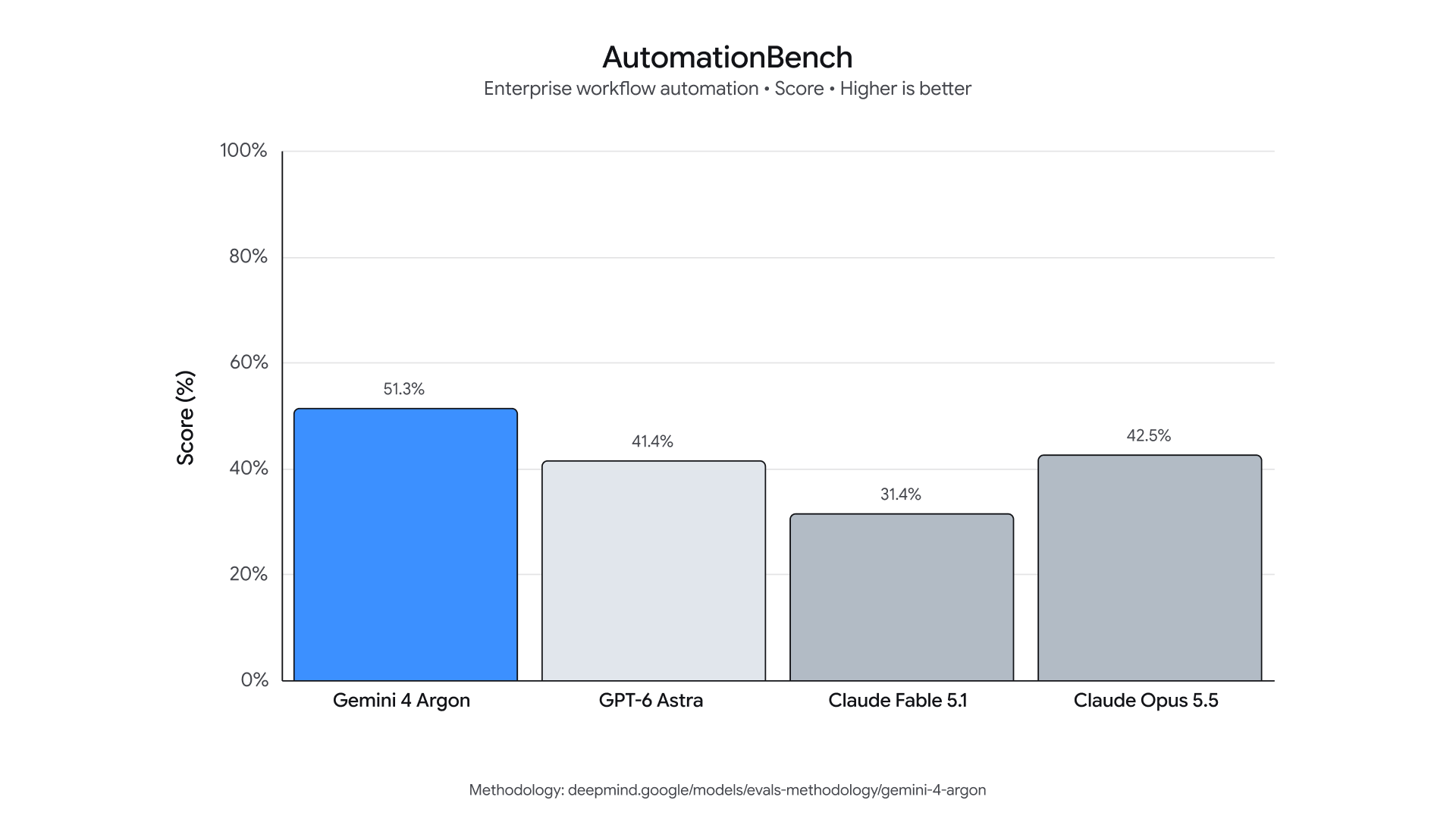
AutomationBench (enterprise workflow automation). Source: Google
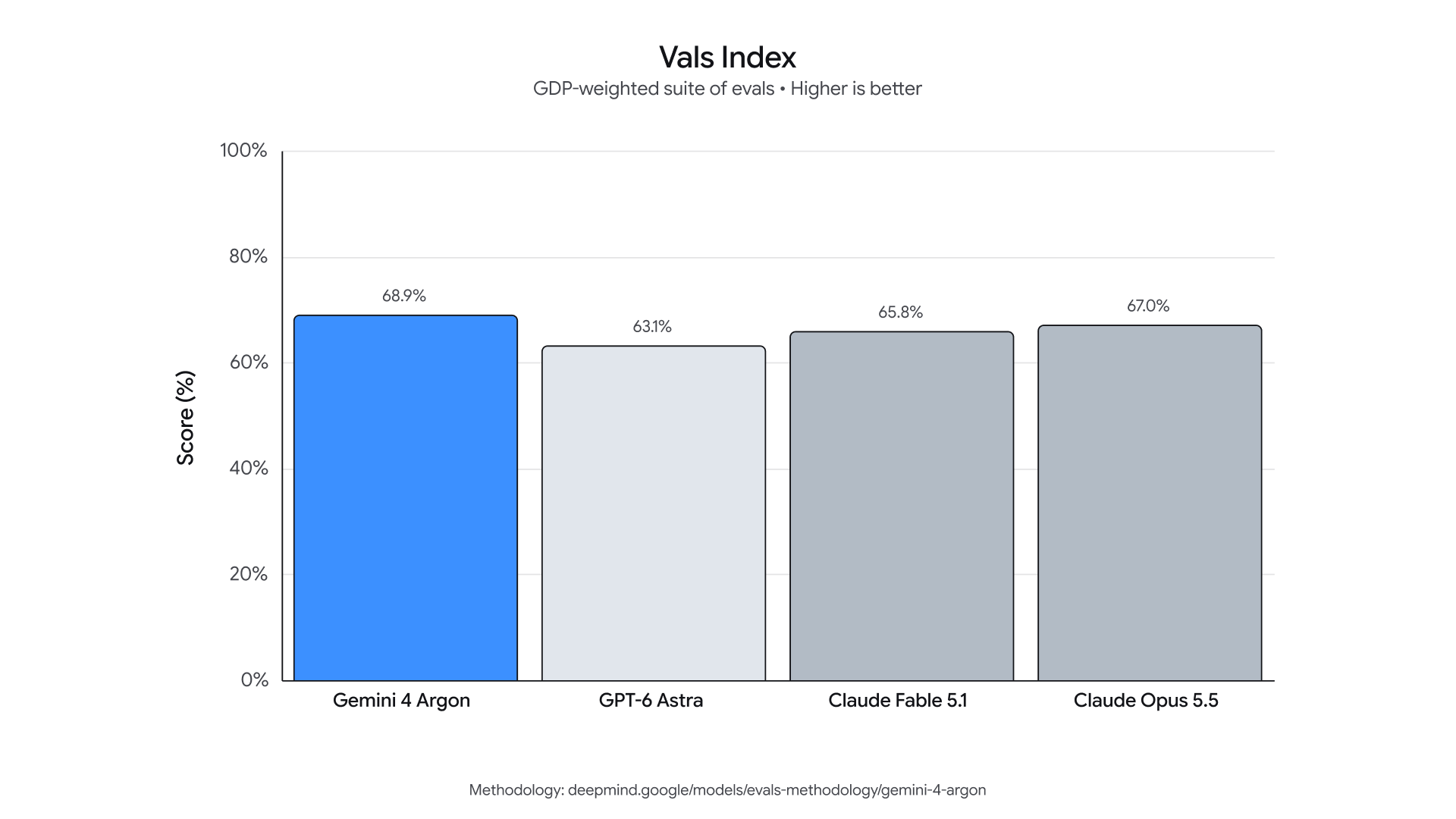
Vals Index (GDP-weighted suite of evals). Source: Google
⚠️ Where Argon trails
Google's own table also shows Argon behind on several agentic coding and terminal tasks:
| Benchmark | Gemini 4 Argon | Leader |
|---|---|---|
| Terminal-Bench 4.0 | 57.4% | Opus 5.5: 66.4% |
| FrontierSWE v2 | 55.0% | GPT-6 Astra: 65.5% |
| PostTrainBench | 45.3% | Opus 5.5: 49.3% |
| OSWorld-2.0 (offline subset) | 69.2% | GPT-6 Astra: 72.6% |
Our read: Argon looks strongest on long-context reasoning, enterprise automation and remediation. On terminal-heavy agentic coding, the competition still leads in Google's own numbers. Run your own evaluations before you switch anything.
🔐 A Defenders-First Rollout
Most people can't use Argon yet. Google is rolling it out first to a set of trusted cyber defenders through its Fairwind Program, a security initiative. For those defenders and for Google's own internal teams, Argon ships "without cyber guardrails", so they get its full defensive capability.
| Phase | Who Gets Access | Timing |
|---|---|---|
| 1️⃣ Now | Fairwind cyber defenders + Google internal teams | Rolling out |
| 2️⃣ Next | Paid API customers and Google AI Ultra subscribers | No public date |
| 3️⃣ Later | Developers, enterprises and consumers more broadly | "As soon as possible", per Google |
Google says it will keep gathering feedback from early testers and keep working on guardrails before it widens access. Its stated safety measures include defenses against cyber and CBRN misuse, resistance to indirect prompt injection (it reports leading results on the Gray Swan IPI benchmark), and misalignment mitigations that monitor Argon's chain-of-thought and actions. Yahoo Finance also reports that Argon is going through the US government's voluntary pre-release review program for frontier models.
💰 Pricing
Google has published both an introductory rate and a standard rate:
| Tier | Input (per 1M tokens) | Output (per 1M tokens) | Cached Input |
|---|---|---|---|
| Introductory | $2 | $10 | 95% off input rate |
| Standard (after intro period) | $4 | $20 | — |
Google hasn't said how long the introductory period will last. For comparison, Yahoo Finance lists Anthropic's Opus 5.5 at $4/$20 and GPT-6 Astra at $10/$50. That puts Argon's standard price level with Opus 5.5 and its introductory price well below both.
💡 Watch the output bill. A 1M-token output limit is a capability, not a target. At the standard $20 per million output tokens, a single response that uses the full budget would cost about $20 in output alone.
🧑💻 What It Means for Teams and Developers
For a software consultancy like ours, the takeaways are practical:
1. 🏗️ Plan for longer, single-pass agent runs
Moving from 64K to 1M output tokens changes what one call can produce: full-module migrations, large test suites, or long research reports without stitching chunks together. Teams should revisit pipelines that were designed around short output windows.
2. 🛡️ Watch the security tooling story
If Google's remediation claims hold up, AI-assisted find-validate-patch loops could end up in CI/CD and code review. Fairwind access is limited to defenders for now, so this is a good time to prepare: inventory your SAST/DAST pipeline and decide where an AI patch step would sit and who approves its output.
3. 📏 Benchmark on your own codebase
Google's numbers show Argon ahead on some coding evals and behind on others, such as Terminal-Bench 4.0. Build a small internal eval set from real tickets, migrations and bug fixes so you can compare Argon against your current model when API access opens.
4. 💸 Budget for the price step-up
Introductory pricing won't last. Model your costs at the standard $4/$20 rate, and design prompts to make heavy use of caching, since cached input is discounted 95%.
5. 🔀 Keep your stack model-agnostic
The frontier keeps moving, with Google, OpenAI and Anthropic trading benchmark leads. An abstraction layer such as a routing gateway or MCP-based tooling lets you test Argon without rewriting your application.
Checklist before GA:
- ✅ Identify two or three long-horizon workflows that hit output limits today
- ✅ Build a private evaluation set from real project work
- ✅ Model costs at standard, not introductory, pricing
- ✅ Define human review gates for any AI-generated security patch
✨ Conclusion
Gemini 4 Argon is Google's clearest bet yet on long-horizon, agentic work. Its main features are a 1M-token output limit, strong claimed results on enterprise and long-context benchmarks, and a cyber-defense focus serious enough that Google is shipping it to defenders before anyone else. The benchmark lead is real in Google's own table but not across the board, and most teams can't use the model yet.
💭 Treat Argon as a model to prepare for rather than adopt today. Get your evaluations, cost models and review gates ready so you can test it properly when access opens.
Tags: #Gemini #Gemini4Argon #GoogleDeepMind #AIModels #Cybersecurity #SoftwareEngineering #AgenticAI #BigMatrixSolutions
Sources:
- Gemini 4 Argon: our next era of frontier intelligence — Google Blog
- Google releases Gemini 4 Argon, called its most powerful model yet — TechCrunch
- Google announces Gemini 4 Argon as its new frontier model — 9to5Google
- Google unveils Gemini 4 Argon, its first flagship AI model since February — Yahoo Finance
- Google debuts Gemini 4 Argon, its latest frontier model — Yahoo Finance
- Google Launches Gemini 4 Argon With a 1 Million Token Output Limit — gHacks
- Google Introduces Gemini 4 Argon, Beats GPT 6 Astra And Opus 5.5 On Many Benchmarks — OfficeChai
Media credits:
- Hero image and benchmark charts — Google