
🚀 Claude Opus 5.5: Fable-Level Performance at a Lower Price
✨ Anthropic's new flagship Opus model is faster and cheaper than Opus 5, and on most work it performs at the level of Claude Fable 5.1.
🌐 Introduction
Anthropic today released Claude Opus 5.5, the first model in its new Claude 5.5 family. The headline is cost as much as capability. Anthropic says Opus 5.5 performs at the level of Claude Fable 5.1 on most work. It also says that at default settings it will cost 40% less than Opus 5 on typical workloads.
The model is live today on the Claude Platform, Amazon Web Services, Google Cloud and Microsoft Azure. Developers can call it through the API as claude-opus-5-5.
💡 Anthropic says Claude Sonnet 5.5 and Claude Haiku 5.5 "will follow in the coming weeks."
For teams that build on Claude, the question used to be "Is the best model worth the bill?" Opus 5.5 makes that question easier to answer.
💰 Pricing: Cheaper Tokens, Fewer of Them
Anthropic cut the per-token price. The model also needs fewer tokens to finish a task, and the company says those two changes together drive the 40% saving.
| Price per 1M tokens | Claude Opus 5 | Claude Opus 5.5 |
|---|---|---|
| 📥 Input | $5 | $4 |
| 📤 Output | $25 | $20 |
| ⚡ Cache reads | $0.50 | $0.20 |
| 🗂️ Cache writes | $6.25 | $5 |
The input and output prices are 20% lower than Opus 5. The cut on cache reads is bigger at 60%. Anthropic notes that cache reads "make up the majority of agentic and coding work costs." For long-running agents that re-read the same context many times, that line in the table matters most.
A fast mode is also listed at $8 input and $40 output per million tokens.
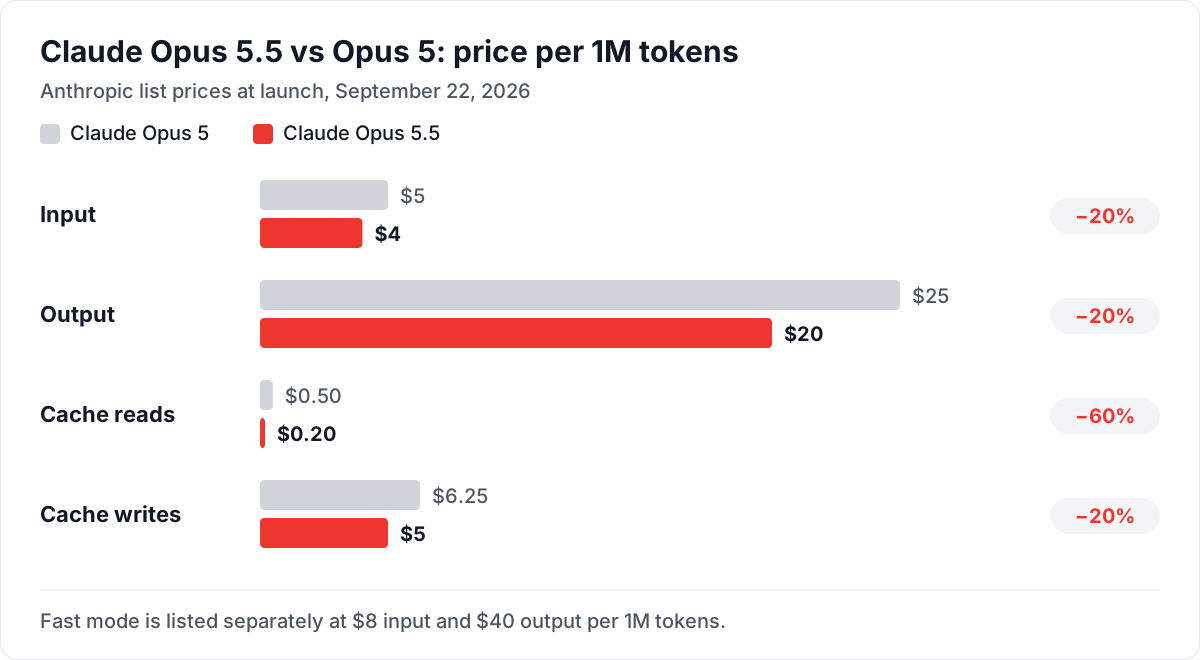
Input, output and cache-write prices fall 20%; cache reads fall 60%. Diagram: Big Matrix Solutions, based on Anthropic.
⚡ Speed: Anthropic says Opus 5.5 "generates output more than 30% faster than Opus 5."
📊 Benchmarks: Opus Catches the Bigger Model
Anthropic published results against Claude Fable 5.1, Claude Opus 5 and competing models. Unless noted otherwise, the Opus 5.5 results use adaptive thinking at max effort, with production safeguards enabled.
| Benchmark | Opus 5.5 | Fable 5.1 | Opus 5 |
|---|---|---|---|
| 💻 Terminal-Bench 4.0 (agentic coding) | 66.4% | 55.8% | 52.3% |
| 🧪 FrontierCode v1.1 (Main) | 54.4% | 50.3% | 48.0% |
| 🖱️ CursorBench 4.0 | 57.8% | 51.8% | 46.6% |
| 📚 GDPval-AA v2.1 (knowledge work) | 1846 | 1735 | 1708 |
| 🔄 AutomationBench (business workflows) | 40.0% | 31.4% | 26.9% |
| 🧠 Humanity's Last Exam (with tools) | 67.7% | 65.6% | 63.6% |
| 🖥️ OSWorld 2.1 (computer use, partial) | 81.8% | 80.7% | 74.0% |
On every row above, Opus 5.5 scores higher than both Opus 5 and the larger Fable 5.1. The scores do not put it ahead of everything else, though. On Anthropic's own chart, OpenAI's GPT-6 Astra scores higher on AutomationBench (41.4%) and on Terminal-Bench-Science 0.1 (64.6% vs. 58.7%).
Anthropic also says that "in our own use, the gap between Opus 5.5 and Claude Fable 5.1 is narrower than these scores suggest". So the benchmark lead does not always show up as a lead in practice.
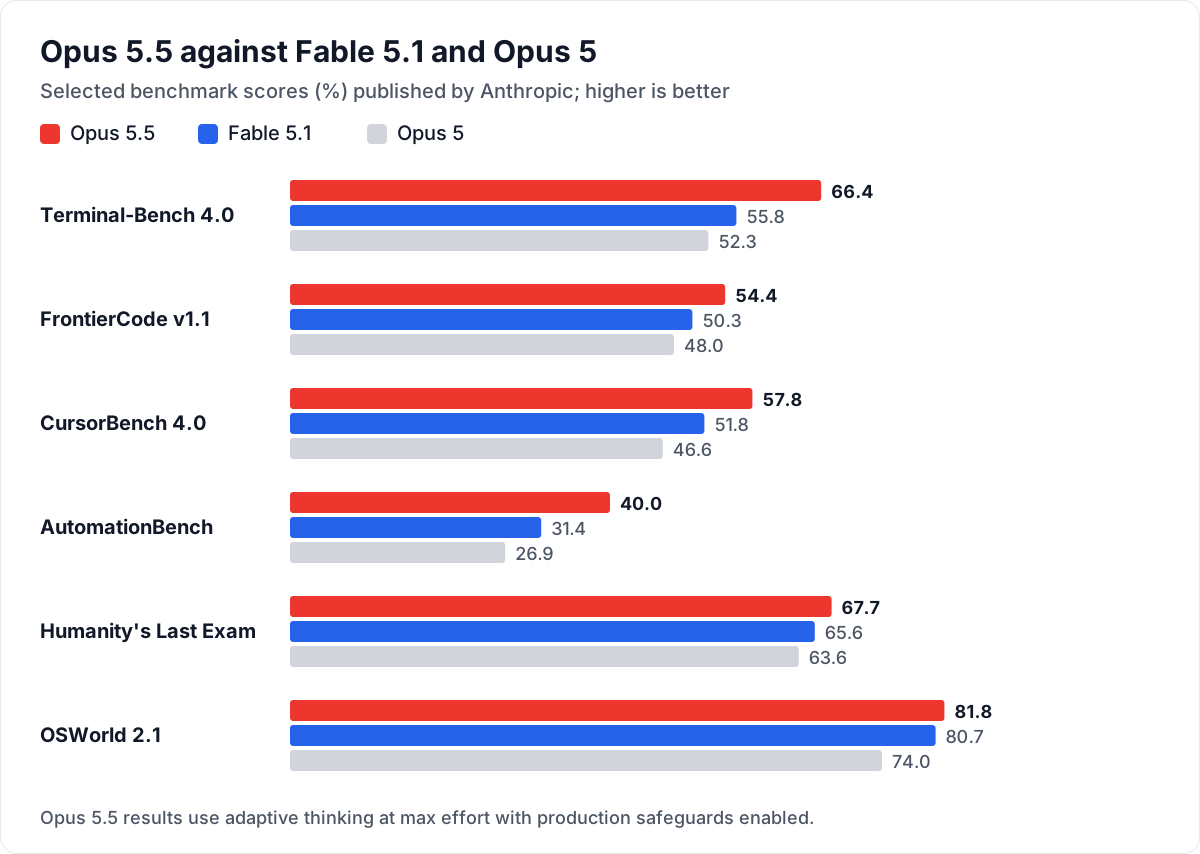
Opus 5.5 leads Fable 5.1 and Opus 5 on each of these six benchmarks. Diagram: Big Matrix Solutions, based on Anthropic.
🛠️ Real-World Signals
Anthropic's announcement includes several examples from early testers:
- ✅ Large codebase audit: One early tester used it to audit and fix a 200,000-line codebase in under three hours. Opus 5 took over 20 hours on the same job and used 2.5x as many tokens.
- ✅ Long unattended runs: Clio says Opus 5.5 worked across six repositories overnight and stayed on task for over 18 hours.
- ✅ Token efficiency: GitHub tested it in Copilot CLI and VS Code and reported that "Claude Opus 5.5 used among the fewest tokens and steps we measured."
🛡️ Safeguards Come Standard
Opus 5.5 is a frontier-class model, and Anthropic is shipping it with matching guardrails. In Anthropic's words, "because Opus 5.5 is comparable to Claude Mythos 5.1 in biology and cybersecurity," it is being deployed "with safeguards similar to those on Claude Fable 5.1."
| Safeguard | What It Does |
|---|---|
| 🔐 Cyber and biology safeguards | Similar to the protections on Claude Fable 5.1 |
| 🧩 Preserved thinking | The anti-distillation safeguard first introduced with Fable 5.1 |
| 🧪 Verification programs | A Life Sciences Verification Program for vetted biology research organisations, and an expanded Cyber Verification Program for verified security practitioners |
Anthropic says Opus 5.5 is its best-performing model to date on its automated behavioural audit. It also attempts to get around containment boundaries 85% less often than Opus 5 or Claude Mythos 5.1.
💭 This is Anthropic's first model since CEO Dario Amodei publicly argued that frontier AI progress should be deliberately paced. Opus 5.5 offers more capability for less money, with tighter controls built in.
👥 More Room for Subscribers
The cheaper model also changes the subscription plans. Anthropic is raising five-hour usage limits on Pro, Max, Team and seat-based Enterprise plans. Subscription users also get a rate limit reset that they can save and use whenever they choose.
🧑💻 What It Means for Teams and Developers
For a software consultancy, every client is asking how to get better AI output without running up costs. Opus 5.5 changes several practical decisions:
| Decision | What to Do Now |
|---|---|
| 🔁 Default model for agents | Re-test workloads that were moved down to cheaper models for cost reasons. Opus-tier quality may now fit the budget. |
| 🗃️ Caching strategy | Cache reads now cost $0.20 per million tokens, so put stable system prompts, repository context and tool definitions behind prompt caching. |
| ⏱️ Long-running tasks | Try overnight refactors, migrations and codebase audits. Early testers report multi-hour unattended runs. |
| 📏 Re-benchmark costs | Measure the cost per completed task, not the price per token. Fewer tokens per task is part of the saving. |
| 🛡️ Security work | If your work includes penetration testing or exploit research, expect the cyber safeguards to apply, and check whether the Cyber Verification Program fits your team. |
✅ Practical next step: Run your three most expensive production prompts or agent loops against Opus 5.5 next to your current model. Compare the total cost, wall-clock time and pass rate before you switch the default.
✨ Conclusion
Claude Opus 5.5 shows that frontier performance does not have to cost more each generation. It is cheaper per token, uses fewer tokens per task and runs faster than Opus 5. Anthropic says that on most work it performs at the level of a larger model. For teams that build agents and coding tools, it is a strong candidate for a new default, as long as you check those numbers against your own workloads first.
💭 The best model for most jobs is now also one of the cheapest options for running them at scale.
Tags: #Claude #ClaudeOpus #Anthropic #AIModels #AgenticCoding #LLMPricing #BigMatrixSolutions
Sources:
- Introducing Claude Opus 5.5 — Anthropic
- Anthropic releases Opus 5.5 with lower prices and Fable-level performance — TechCrunch
- Anthropic launches Opus 5.5, its first model since CEO Amodei called for AI slowdown — Yahoo Finance
Media credits: